
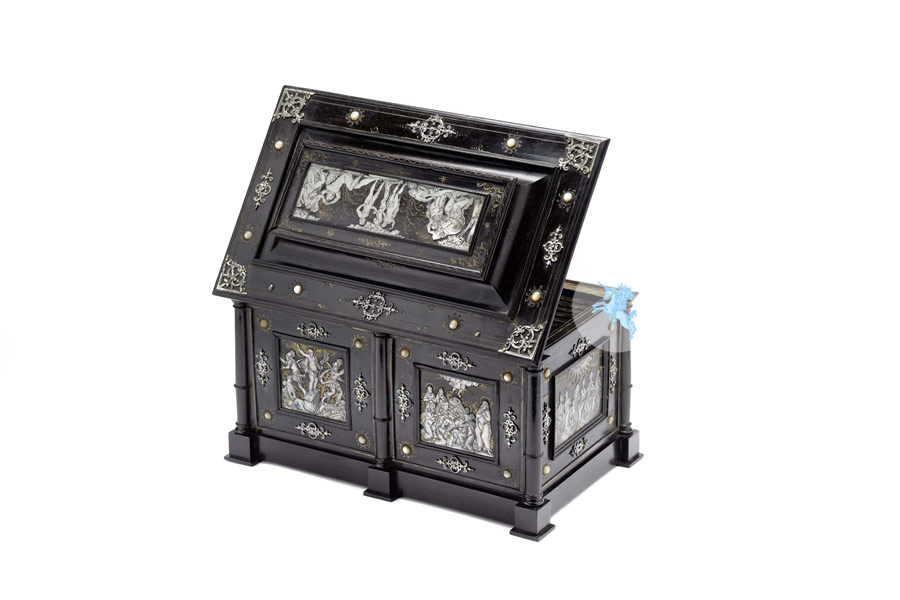
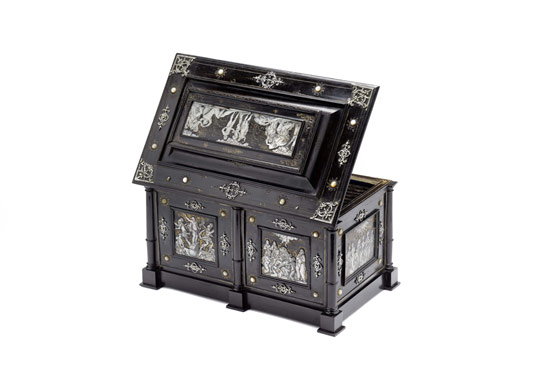
Court jewellery casket with mother-of-pearl engravings
Augsburg, ca 1620
Veneer: ebony, partly engraved and with gold painting; mother-of-pearl, partly engraved and with gold painting; silver plaquettes; carcase: spruce; lined with blue silk
Height ca 17 cm, width ca 28 cm, depth ca 17 cm
Provenance: Dänemark, private collection
SOLD - Please contact us for similar artwork!
The box part of the casket that rises above a low, slightly recessed base is articulated and framed by demi-columns and surmounted by a coffered lid. The austere design of the ebony casket is enhanced not only by pierced silver fittings but also by engraved and gold-painted decorations, small round mother-of-pearl cabochons and engraved mother-of-pearl intarsia, grouped to form figurative scenes in six square fields. The representations illustrate episodes from the Old Testament and the New Testament. First confronted with the Creation of Adam and Eve and The Fall on the lid, viewers progress to the Life of Christ: the New Testament cycle starts on the front of the casket with The Annunciation and The Adoration of the Shepherds: The Crucifixion is on the left-hand narrow façade, The Resurrection and The Ascension are on the back while The Outpouring of the Holy Spirit is on the right-hand narrow façade. The design of the interior shows that this exquisite casket was a jewellery box: The lid opens to reveal a ring holder on the right-hand side of the casket and two small drawers for more jewellery. The magnificent casket was made in Augsburg. The elegant silver fittings are one feature that argues strongly for this assumption: they recur in similar design on a great many early seventeeth-century ebony cabinets made in Augsburg, and might, for instance, have been produced at the workshop of the Augsburg goldsmith Matthias Wallbaum, the artisan from whom many Augsburg Kistler [‘chest-makers’] acquired silver plaquettes for the sumptuous furnishings they made. Another indication that the casket was made in Augsburg is its form: its articulating demi-columns are characteristic of Augsburg furniture from the first half of the seventeenth century. Engraved mother-of-pearl intarsia, on the other hand, had belonged to the repertory of south German gunsmiths since the latter half of the sixteenth century. In Nuremberg and Augsburg Kistler integrated the precious material into their finest products. This is shown by a games box at the Hessisches Landesmuseum in Kassel with ebony veneer that also boasts engraved and gold-painted decoration as well as engraved mother-of-pearl intarsia. The engraved and parcel-gilt silver plaquettes and intarsia show that this games box was made in Augsburg because they are almost identical in style and execution to the ones on the games board in the Pommerscher Kunstschrank, which Hainhofer commissioned to be made in Augsburg for Philipp II of Pomerania between 1612 and 1615. Consequently, the games box in Kassel and the jewellery casket discussed here are both prime examples of Augsburg work of this kind and were made in the first quarter of the seventeenth century.