
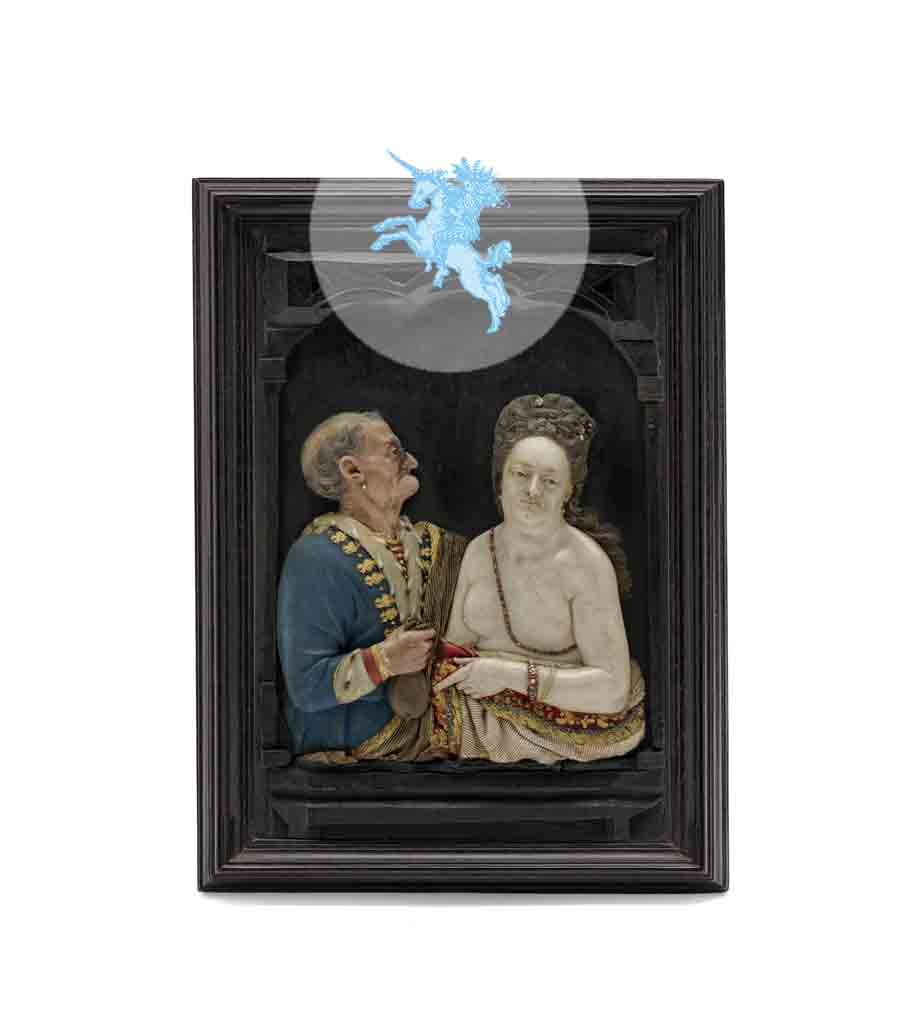
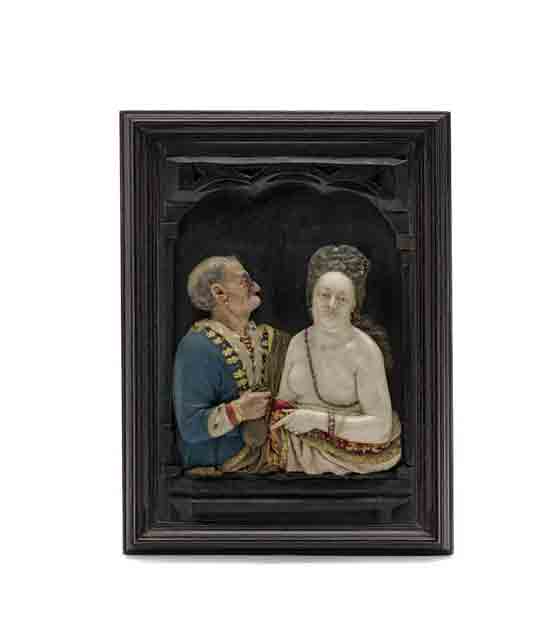
The Unequal Couple
Anna Maria Braun
Durlach or Nuremberg, ca 1670
Wax, tinted, in part painted and gilded, on slate, glass stones, pearls, cloth; frame: wood
Dimensions with frame: height 24 cm, width 17.5 cm, depth 3.5 cm
Provenance: Paris, J. Kugel
This wax relief in a small format is revealed as a gem of ceroplastic art with its sophisticated use of material properties, fine sculptural handling and harmonious composition, features that are shown to particular advantage by the simple black background. The figures depicted represent a mésalliance – a theme that had been extremely popular in the fine arts since the sixteenth century. Attribution of the relief to the celebrated ceroplast Anna Maria Braun (1642–1713) is based on comparison with stylistically related, signed works by the artist, some of which are held by the Kunsthistorisches Museum in Vienna (Inv. No. PS 9901), the Landesmuseum in Kassel, the Skulpturensammlung in Berlin (Inv. No. 7992) and the Herzog Anton Ulrich-Museum in Brunswick (Inv. No. Wac 6). Born in Lyon in 1642, Anna Maria was the daughter of Georg Pfründt (1603–1663), medallist, sculptor and ceroplast. She learned the art of wax modelling from her father and moved with him to Durlach when Friedrich VI, Margrave of Baden-Durlach (r. 1659–1677), summoned Pfründt to his court. In 1659 she married Johann Bartolomäus Braun († 1684) in Durlach, where he was private secretary to the margrave but was also active as a medallist and painter. She later moved with her husband to Nuremberg and remained there after his death in 1684. During that time Anna Maria Braun travelled regularly to meet her clientele in person. She ultimately settled in Frankfurt am Main, where she died in 1713. In his Teutsche Academie (1675) Joachim von Sandrart praised Anna Maria Braun early on in her career for her skill and pointed out her affinity with the Renaissance wax modeller Antonio Abondio (1538–1591). Like Abondio Anna Maria Braun integrated pearls and set stones, i. e. glass stones, in her compositions in small formats. She also used cloth and real hair. These combinations of materials with tinted and polychromed wax were the qualities of her work her contemporaries particularly prized. How highly esteemed Anna Maria Braun was is shown by her portraits of rulers. The ceroplast worked not only for the margraves of Durlach-Baden but also for the archbishop of Mainz, the landgrave of Hesse-Kassel, the margraves of Baden-Baden and the dukes of Saxony-Gotha-Altenburg. She was summoned to Vienna to model portraits of the Emperor Leopold I (r. 1658–1705), his family and some members of the imperial court. She also went to the Netherlands to create a wax portrait of William III, Stadholder of Orange (1650–1702). Furthermore, she produced portraits of Lothar Franz of Schönborn-Buchheim (1655–1729), Archbishop-Elector of Mainz, Carl XII of Sweden (r. 1697–1718), Johann Wilhelm, the Elector Palatine (r. 1690–1716), and Prince Eugene Francis of Savoy-Carignano (1663–1736) – in brief, the most important art collectors and patrons of the arts of her day.