

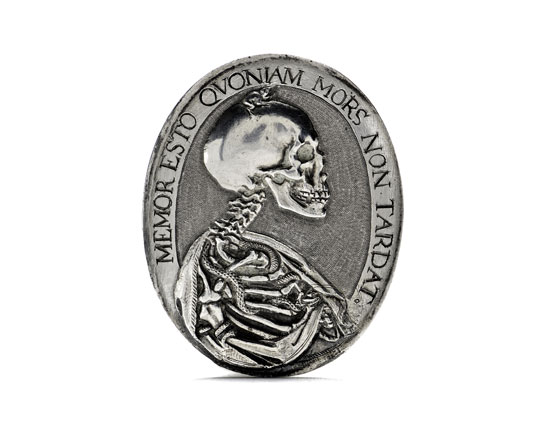
Memento Mori medallion
Jan de Vos (1578–after 1619), monogrammed IV
Augsburg, 1612
Silver, cast, punched, engraved and chased
Monogram ‘IV’ in the sleeve slash on the portrait bust of a lady
Height 5.8 cm, width 4.8 cm
Published: Meininghaus, H.: Memento Mori. Hermann P. Lockner zum 65. Geburtstag, in: Weltkunst 71 (2001), No. 12, pp. 1856–1859, p. 1857
SOLD - Please contact us for similar artwork!
In this superlatively worked silver medallion, the Augsburg goldsmith Jan de Vos (1578–after 1619) created a precious memento mori piece, which would have been viewed as a Kunstkammer object of the first water in the early seventeeth century for its iconography, the material of which it was made and its aesthetic value as a work of art. On one side of the medallion a young woman is depicted in the prime of life and beauty: with naked breasts, an elaborate hairstyle with coiled braids and adorned with valuable jewellery. The head of the bust is framed by the Latin inscription ‘NE GLORIERIS IN CRASTINVM’ [‘Boast not thy selfe of tomorrow’]. Thus the Vanitas theme is broached, which is then expressed in stark visual and verbal terms on the reverse of the medallion. There a skeleton emerges – literally out of the back of the young woman on the obverse – as a personification of Death, framed by the ominous warning from the Vulgate: ‘MEMOR ESTO QVONIAM MORS NON TARDAT’ [‘Remember that Death is not slow’]. A serpent as an allusion to the Fall as the cause of human mortality coils about Death’s ribs. A toad, on the other hand, crouches atop the skull of the skeleton. According to the Physiologus, an Early Christian treatise from the second century, the amphibian was viewed as a symbol of the Resurrection because it burrowed into the ground during drought, only to resurface when it rained. With this symbol the exquisite memento mori medallion reminds viewers of the transience of earthly existence while at the same time it points out that attaining eternal life is contingent on leading a life grounded in Christian principles. The artist who created this precious work in silver is identified by the monogram beneath the slash in the young woman’s sleeve: the initials ‘IV’ stand for Jan de Vos, a goldsmith of Netherlandish origin who settled in Augsburg, where his renown enabled him to target a court clientele with his sophisticated works. In 1606 Jan de Vos was appointed goldsmith to the imperial court by the Emperor Rudolph II (reign 1576–1612) – a position the artist continued to hold under the Emperor Matthias (reign 1612–1619) and his wife, the Empress Anna (reign 1612–1618).