

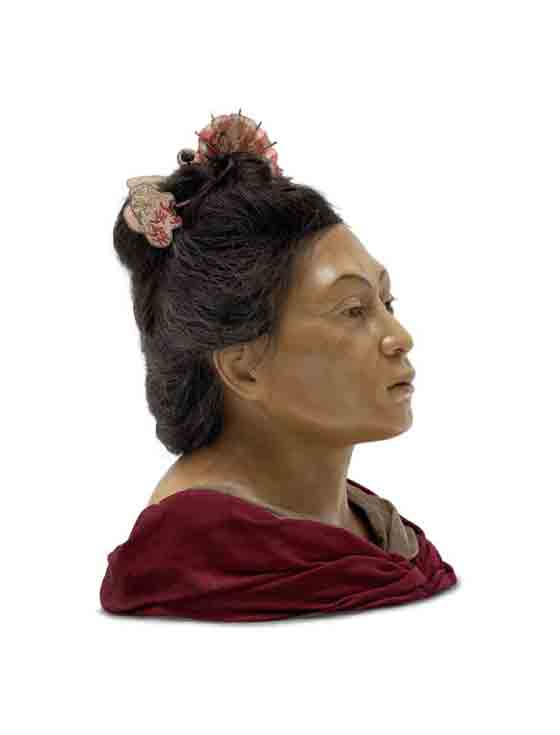
Wax bust of a Japanese woman
from the Edo period from Behrendt’s Panopticon
Richard Kotschi (1854–1908)
Leipzig, 1886
Wax, tinted and in part painted, real hair, glass eyes, paper, silver comb, cloth; original display case: wood, glass Glued-on inventory label: ‘515 Japanerin’
Height 43 cm, width 30 cm, depth 30 cm
Provenance: ca 1886 until 2010, Behrendt’s Panopticon and Heirs, Herford (Germany)
Published in: Laue, G.: The Beauty of Mankind. Wax From the Renaissance Kunstkammer to the modern Panopticon, Munich 2026, Cat. No. 22
This bust, a representation of a Japanese woman, differs from the nine other ‘ethnographic busts’ that the Leipzig ceroplast made in 1886 for Behrendt’s Panopticon in that the hair is elaborately styled, featuring a silver comb and ornaments of printed and folded paper. The bunches of hair pinned up at the back of the figure’s head and along the parting are a simplified variant of the diverse hairstyles known from the Edo period (1603–1867). During that period, which is sometimes called ‘The Golden Age of Hairstyling’, long, smooth tresses that were pinned up to form sophisticated hairstyles were regarded as an essential element of the feminine beauty ideal. At the same time such elaborate hairstyles symbolised social status and wealth. The traditional hair ornament, known as ‘Kanzashi’, which is imitated here with a comb and paper ornaments, also usually referred to the wearer’s social status depending on the material it was made of and the way it was worn. The elaborate hairstyle boasted by the Japanese woman represented here stands as a pars pro toto for the cultural achievements and highly civilised social practices for which Japan had been admired in Europe since the Renaissance. In the early modern age East Asia did, in fact, occupy a special niche in the European perception of foreign cultures. This is shown in the objects of Asian provenance that European collectors assembled in their Kunst- and Wunderkammer between the sixteenth and eighteenth centuries: calligraphic works, Tea Ceremony accessories, lacquers and porcelain attest the high status accorded the artworks and cultural achievements for which Japan and China famously stood. At the turn to the twentieth century a representation of a Japanese woman belonged to the indispensable repertory of exhibits featured by the ‘Galleries of Peoples’ most panopticons presented. To take just one example, the International Trade and Commerce Panopticon in Munich possessed a similar ceroplastic artwork, which is described in the 1895 guide to that panopticon as an ‘elegant Japanese lady’. Wax busts of this kind reflected Western admiration of aesthetic values shaped by the way Japanese women looked in the Edo period. The focus on hair is all the more significant since in Japan a trend towards Western standards set in with the dawn of the Meiji period in 1868: short hair became a symbol of a modern, Western-influenced age. Elaborate hairstyles, by contrast, tended by then to be associated more than ever with the traditions and ideals of Old Japan.