

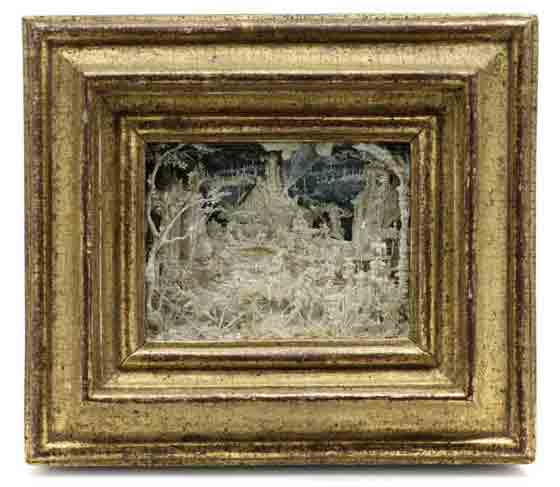
The Flight to Egypt
Nikolaus Engelbert Cetto (1713-1746), signed
Tittmoning near Salzburg, ca 1740
Wax on glass plate primed with black wax, bleached with white lead and configured with an array of natural substances (animal hairs, wire, twigs and fish bones), selenite; original display case and frame: wood, in part gilded, glass Monogram ‘NEC’ bottom lefts
Height 14 cm, width 16 cm, depth 3.5 cm
Provenance: Germany, private collection
Published in: Laue, G.: The Beauty of Mankind. Wax From the Renaissance Kunstkammer to the modern Panopticon, Munich 2026, Cat. No. 10
This extremely small wax tableau, which has survived in its original gilded frame, is characteristic of the œuvre produced by the Cetto family of wax modellers, who were active in Tittmoning in the Prince-Archbishopric of Salzburg during the first half of the eighteenth century. The NEC monogram in the lower lefthand corner proves that this is a work by Nikolaus Engelbert Cetto (1713–1746). Like his father, Johann Baptist Cetto (1671¬¬–1738), Nikolaus Engelbert specialised in ivory-tinted wax micro-tableaux in which he used natural materials such as twigs, fish bones and pig’s bristles to form minute, three-dimensional pictorial elements to create architectural scenes set in steeply staggered landscapes. The consummate mastery the wax modeller had of his medium is clearly expressed in this extremely delicate micro-sculpture. He has represented The Flight to Egypt in a pyramidal composition. Whereas Bethlehem is discernible in the background as a town on a hill, the Virgin and Child are displayed at the centre of the picture on a donkey. St Joseph stands next to them holding a shepherd’s crook. He is turning to address a figure on a stair: this is probably the angel who has warned him about Herod’s intentions and encouraging him to flee. As a sign of the Divine presence, the artist has placed a selenite ray of light in the sky above the Holy Family. In this, as in all compositions by the Cettos, a host of human figures and animals are packed into the smallest possible space that, however, effectively suggests a seemingly sweeping landscape. A motif especially typical of Nikolaus Engelbert is the staircase with bannisters in the foreground, right, which looks like lace. It was, in fact fashioned of silk threads that were dipped in molton wax. Nikolaus Engelbert and Johann Baptist found a broad clientele for their exquisite wax tableaux in southern Germany. There are more than two hundred wax micro-tableaux by the Cettos, father and son, worldwide in public and private collections. One hundred and twenty-six of them alone belong to St Peter’s Abbey Church in Salzburg. This Cetto collection owes its existence to an art-loving abbot, Dominikus Hagenauer (1746–1811), who esteemed the two Salzburg artists and assembled as many works of theirs as possible four decades after their deaths to enrich the Abbey collections. Unsurprisingly, two more wax representations of the Flight to Egypt are held by St Peter’s Abbey Church: one is marked with the monogram IBC (Inv. No. O 965) as the work of Johann Baptist Cetto; the other, albeit without a monogram (Inv. No. O 573), can be attributed to either the father or the son.