
Astronomical compendium
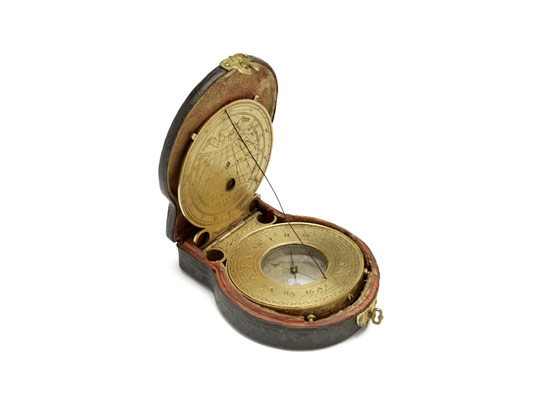
in its original leather case
Johann Anton Linden (active 1585–1605), attr.
Heilbronn, dated 1597
Brass, engraved and fire-gilt, glass, silver
Case: Tooled leather, engraved and fire-gilt brass
Inscription: ‘TOTA VITA DIES UNUS EST’ (All of life is one [long] day)
Dimensions of the compendium: diameter 7 cm, height 8 cm
Its tooled leather case with its fire-gilt and engraved brass hasp are striking indications of the quality and value of this astronomical compendium, which is distinguished by its unusual form, elaborate engraved decoration and outstanding condition as a piece of Renaissance scientifica of the highest quality. Astronomical compendia that incorporated several devices for measuring time as well as astronomical and astrological computing and observational instruments were particularly popular in the latter half of the sixteenth century. The present compendium was made in 1597. That is shown by the calendar that is engraved in a ring encircling the nocturnal and applies to the years 1597 to 1634. The lunar volvelle (wheel chart) is fastened to the middle of the calendar: it consists of a rotating disc with a hand by means of which the phases of the moon, sunset and sunrise can be determined. Two more rings around the movable disc function as a concordance between the Julian calendar and the Gregorian Calendar, which Pope Gregory XIII had introduced shortly before, specifically in 1582. A compass with 32 points is drawn on the back of the compendium and a small round aperture has been worked in to ensure the needle of the compass beneath it is visible. The compendium opens to reveal a sundial; on one side there is a compass and dial, on the other a stereometric projection with the signs of the planets. Here a Latin saying, ‘TOTA VITA DIES UNUS EST’ (All life is only one [long] day’), is inscribed to refer the user of the clock to the relentless passage of time and the memento mori character of this scientific compendium. Attribution of the unusual piece of scientifica to Johann Anton Linden (active 1585–1605), an instrument-maker in Heilbronn, is based on comparison with a stylistically related compendium in the British Museum in London, which, according to the inscription on it, the master made in 1596 for Christoph Leibfried (1566–1635), composer to the court of Julius Echter von Mespelbrunn (reign 1573–1616), Prince-Bishop of Würzburg. Other signed works by Johann Anton Lindau are a beaker sundial (1594) in the Stadtmuseum in Lindau, an astronomical wall clock (1604) in the Landesmuseum in Zurich and an astrolabe in History of Science Museum in Oxford.