
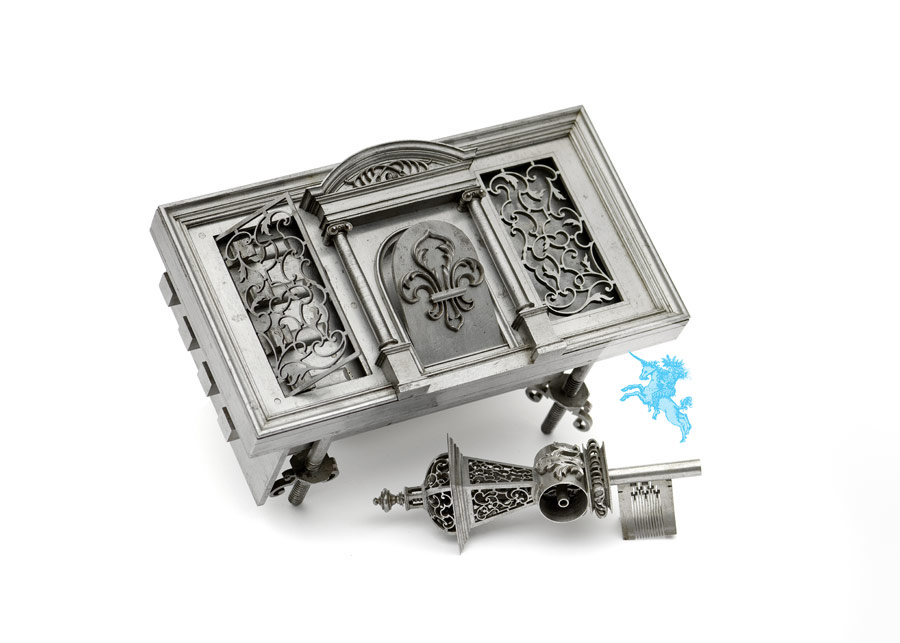
Masterpiece lock with lantern key
Jean-Baptiste Platon, attr.
Lyon, ca 1720–1730
Wrought, moulded and pierced iron
Height 10 cm, width 18 cm, depth 8 cm
Length of key 12 cm
SOLD - Please contact us for similar artwork!
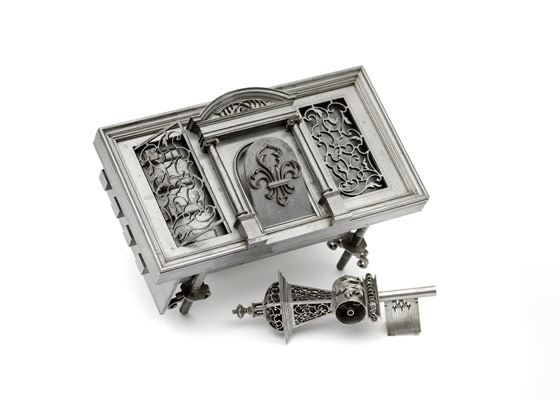
This magnificent complex plate lock, which has survived with its original lantern key, is stunningly architectural in form and boasts elaborate decoration in cast and cut steel. A noteworthy feature apart from the grille-like plaquettes flanking the imaginary portal is the centred fleur de lys boss in high relief, which, as the flower is the emblem of the French royal family, identifies this work of art as a prime example of fine French craftsmanship. The sophisticated unlocking mechanisms are also an indication of the quality of this outstanding piece. The keyhole is hidden behind the central round arch with the fleur de lys. The markedly architectonic articulation of the lock-plate with framing columns and a tympanum does indeed suggest that the round arch might be a door. However, a secret mechanism must be triggered to open it. To do so, the viewer must spot the button in the tympanum, which is camouflaged as sculptural ornament: a flower calyx hanging down at the centre between two palm fronds can be pushed up. Triggering this secret mechanism causes the central door and the left-hand grille to pop open. The keyhole into which the precisely cut bit of the key is inserted is concealed behind the central door. Turning the key in the lock moves the four dead bolts behind the left-hand grille and visually demonstrates the unlocking process. In the eighteenth century journeyman locksmiths made showy complex locks of this kind to present to their guilds as masterpieces to qualify them for master craftsman status. This certification procedure is attested in various sets of guild regulations for master craftsmen as well as design drawings by a number of master locksmiths. In 2007 a magnificent, privately owned lock was published from La fidèle ouverture, an exhibition devoted to locksmithing at the Musée Le Secq des Tournelles in Rouen. The Rouen exhibit is of paramount significance for attributing the present work to Jean-Baptiste Platon (active 1714–1744), a locksmith in Lyon. The magnificent lock shown in Rouen is a complex plate lock with a lantern key and is virtually identical in form, decoration and locking mechanism to the lock and key discussed here. The former bears in the tympanum of the lock-plate and on the key the intials ‘JBP’, which refer to Jean-Baptiste Platon, ‘maître serrurier’. Born in Laus-le-Villard in Savoy, Platon emigrated to France, and was naturalised in 1714. He may have attained master craftsman status that year or soon afterwards. In any case, by 1717 he was a ‘maître serrurier’: That year he was paid the considerable sum of 15,000 livres for forging elaborate wrought-iron grilles to enclose the equestrian statue of Louis XIV, which was in place on Place Bellecour in front of the Lyon town hall by 1724. Platon was among the master craftsmen who were guild jurors in 1731, a status that implies he was highly regarded. The 1744 Almanach astronomique et historique de la ville de Lyon is an instructive source on Platon, who was then domiciled at quai de Retz: he is named in it as one of two recommended locksmiths in Lyon.