
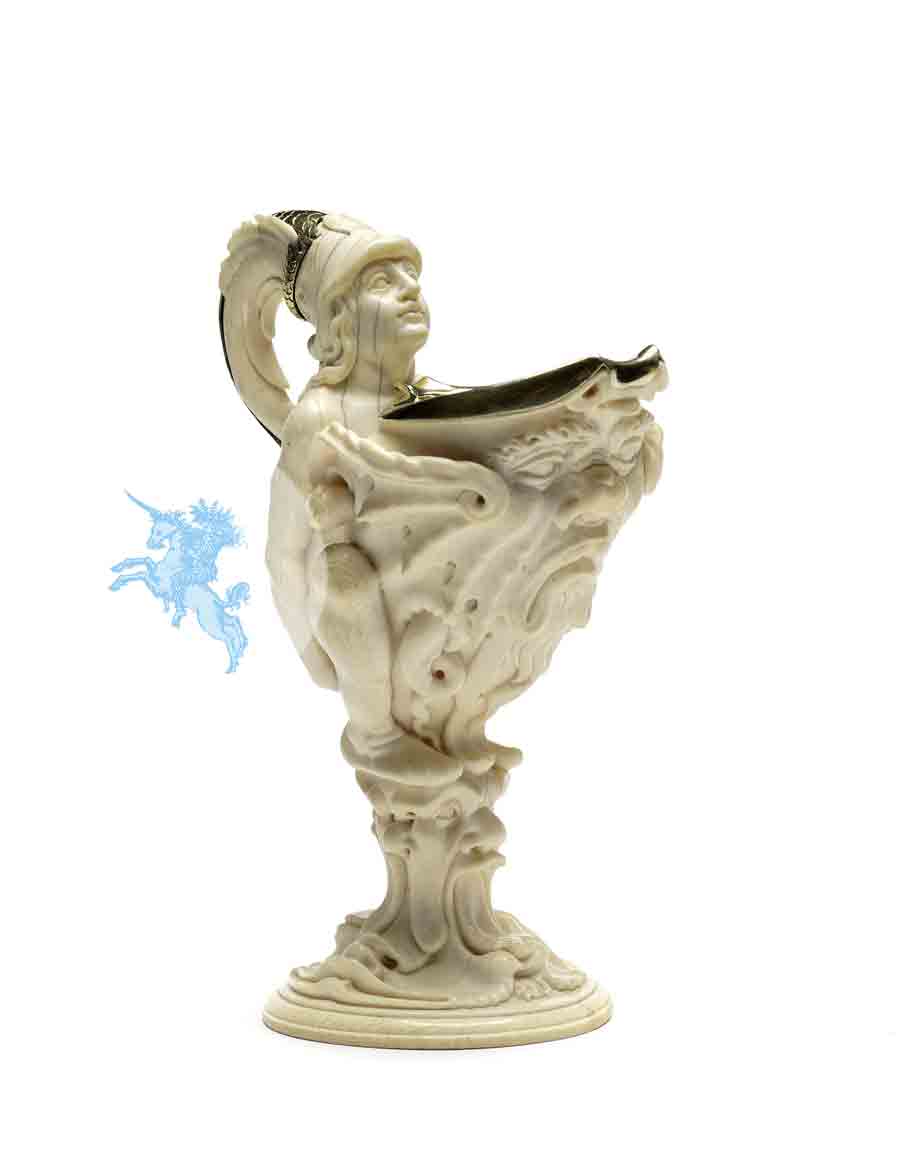
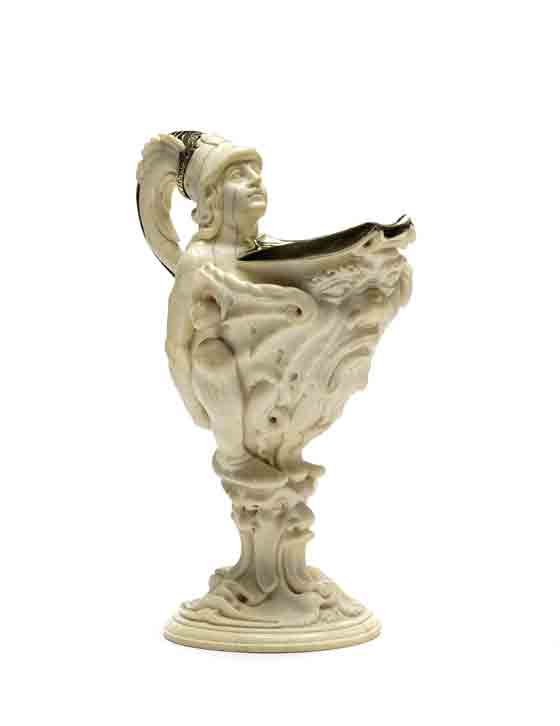
The Grimacing Goblet
Nikolaus Pfaff
Prague, ca 1608
Ivory, fire-gilt silver
Height 18.5 cm
Provenance: Prague, Hermann Freiherr von Attems (1564–1611),
Grand Master of the Court to the Emperor Rudolf II (1607–1609) in Prague; by descent in the Austrian noble family until 2017
Published in: Laue, G.: The Grimacing Goblet by Nikolaus Pfaff, Prague 1608, Kunstkammer Edition 7, Munich 2022
SOLD - Please contact us for similar artwork!
Made around 1600 at the Prague court the Grimacing Goblet is a major Kunstkammer artwork characterized by its extravagant form and refined sculptural design, in which mythical creatures, human figures, mascarons and grimacing faces melt together. This highly unusual and virtuoso ivory sculpture is the work of the Prague sculptor Nikolaus Pfaff (1556-1612), who worked at the court of Rudolf II and specialized in creating valuable Kunstkammer sculptures of ivory and rhinoceros horn. The attribution of the Grimacing Goblet to Nikolaus Pfaff is based on a comparison with the ivory and rhinoceros-horn sculptures from the imperial collections, which are documented by the inventories of the Imperial Kunstkammer as works by Nikolaus Pfaff himself and are still on display in the Kunstkammer of the Kunsthistorisches Museum in Vienna. Also worth mentioning are two almost nearly identical ivory jugs with mascarons in the Museum of Fine Arts in Boston and in the Fitzwilliam Museum in Cambridge, which are also attributed to Nikolaus Pfaff. The fact that the Grimacing Goblet is indeed a major work of Rudolfine court art is shown not least by its prestigious provenance: it comes from the estate of Baron Hermann von Attems, who worked in Prague from 1607 to 1609 as a privy councilor and Grand Master of the Court to Emperor Rudolf II. With its playful forms and technical-artistic virtuosity, the Grimacing Goblet is one of the most unusual and high-quality Kunstkammer objects created at the court of Emperor Rudolf II around 1600.