
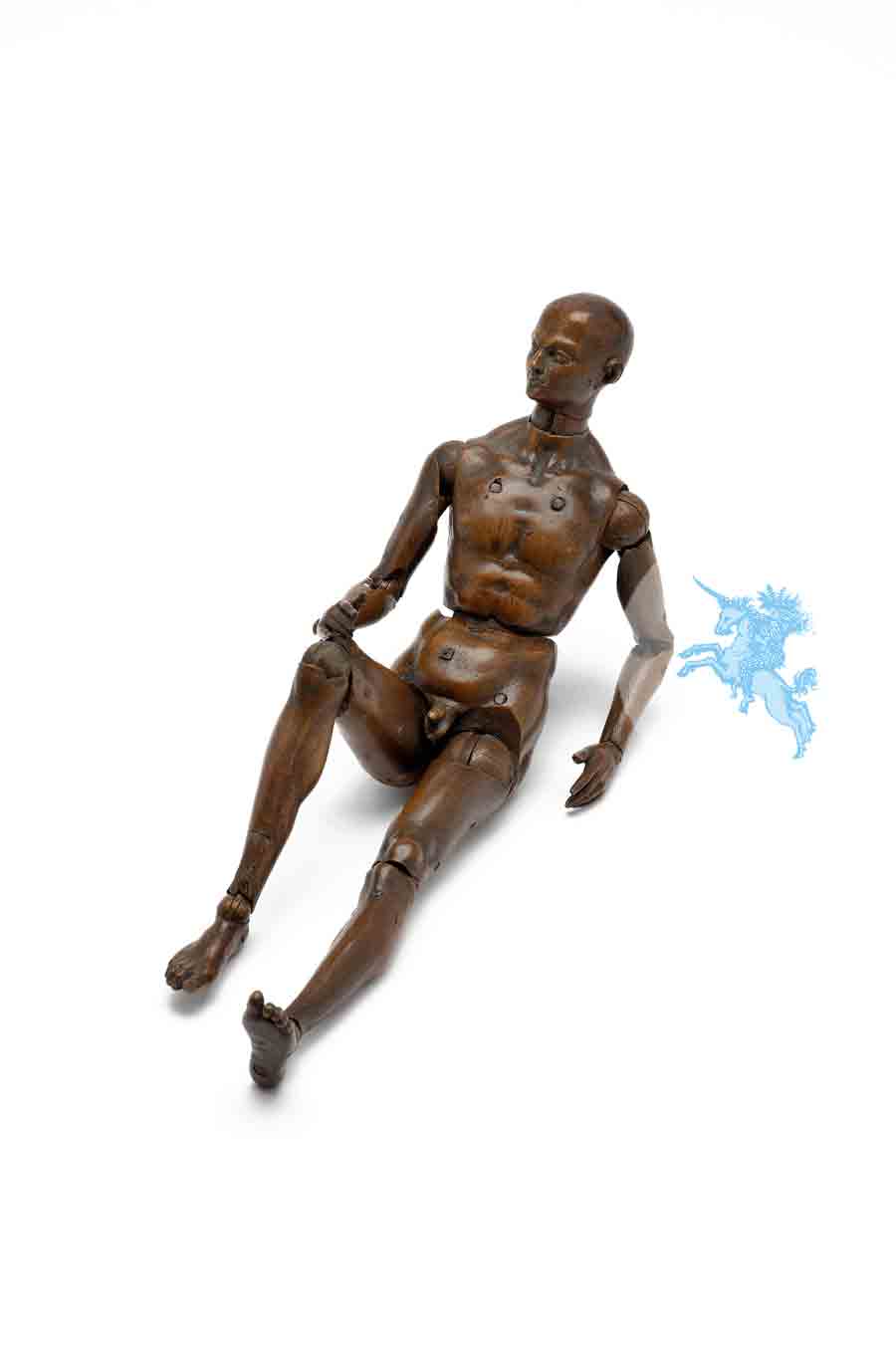
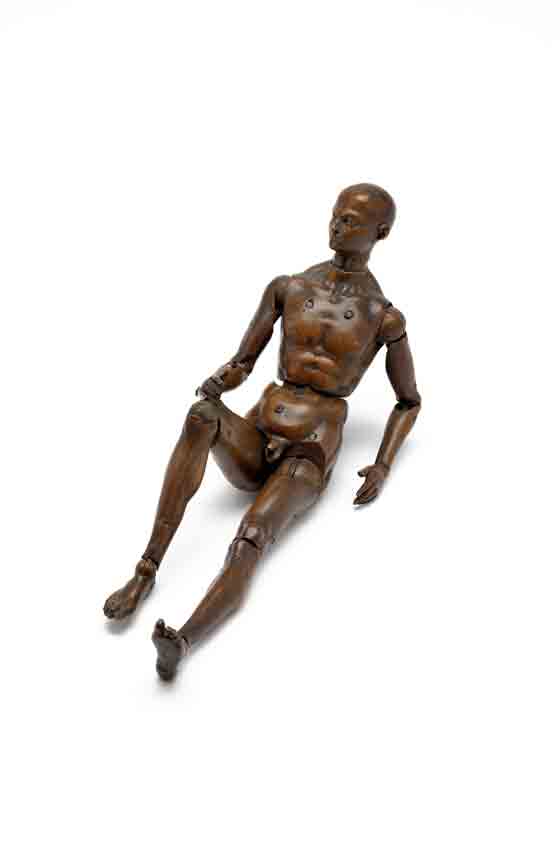
Articulated mannequin
Probably German, first half of the 17th century
Boxwood; base: wood, iron
Length of figure ca 32 cm
Height with base ca 36 cm
SOLD - Please contact us for similar artwork!
This male lay figure is striking because it is so exquisitely modelled. The artist has particularly emphased the muscles and anatomical features of the male body. It is not just the head that is remarkable for the accurate reproduction of the facial features: the individual strands of muscle and sinews are discernible on the hands and feet as well as at the base of the neck. The abdominal muscles have been also clearly picked out. Thus, this sculpture joins the tradition of anatomical studies that assumed a decisive role in painting and sculpture since the late 16th century. Unlike the sculptural nudes and ecorchés of the early 17th century, this present figure is designed as a movable sculpture thanks to its ball joints: the head, torso, hips, legs, arms and hands can be moved to simulate different poses. There is an almost identical lay figure in the Museo Nazionale del Palazzo di Venezia in Rome, which is also represented with the muscles unusually emphasised. Apart from two mannequins in the Bayerisches Nationalmuseum in Munich and the Konstmuseum in Göteborg, the mannequin in the Nationalmuseet in Copenhagen is worth mentioning because it is similar in style and proportion to the present figure. The Copenhagen mannequin came from the Royal Danish Kunstkammer, to which it was added before 1674 according to inventories of the collection. This provides a terminus ante quem for dating the lay figure discussed here: it was made in the 17th century before 1674. The portrait of an unknown sculptor with a mannequin made by the Dutch painter Werner van den Valckert in 1624 suggests that the present sculpture was created in the first half of the 17th century: Here a similar, albeit larger, male lay figure is depicted with the same ball-and-socket joints and with finely worked musculature.