
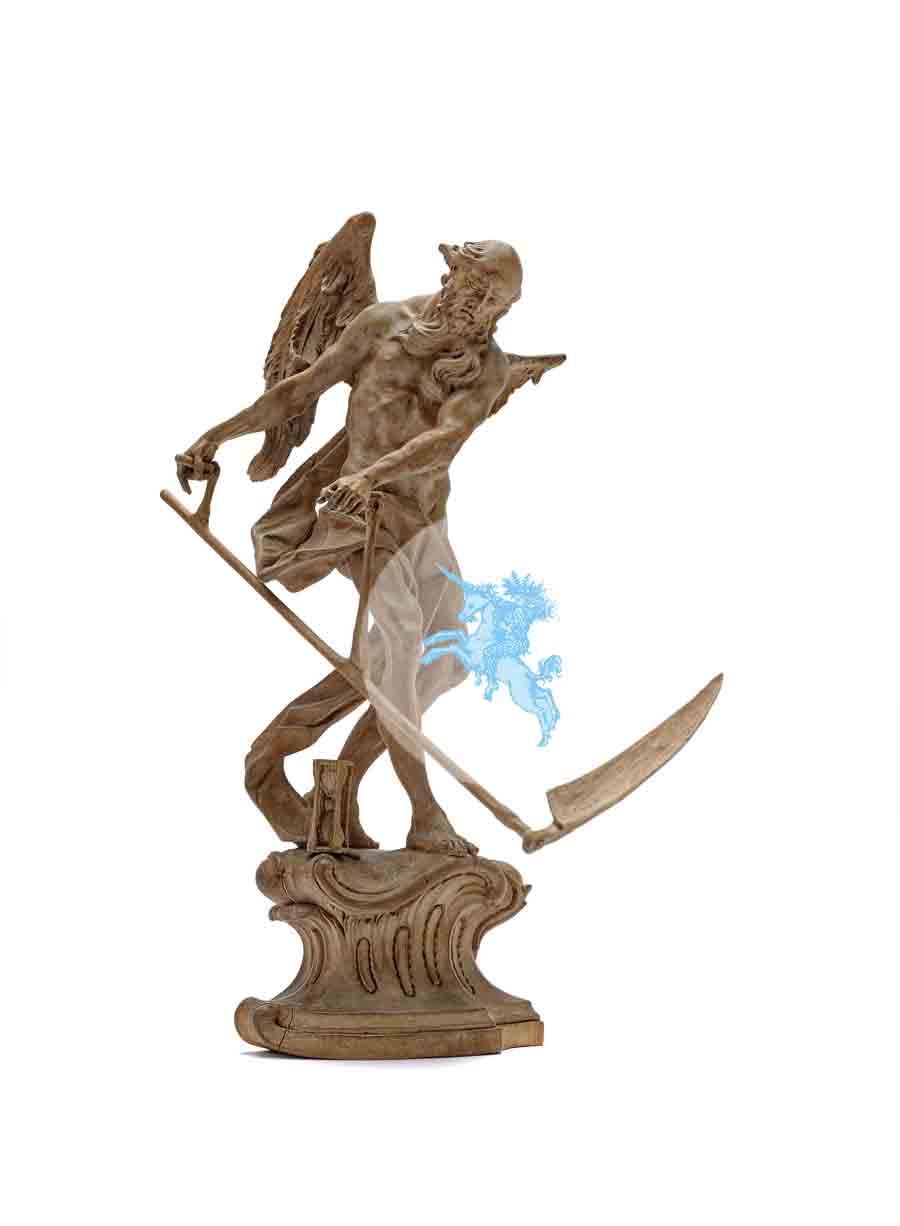
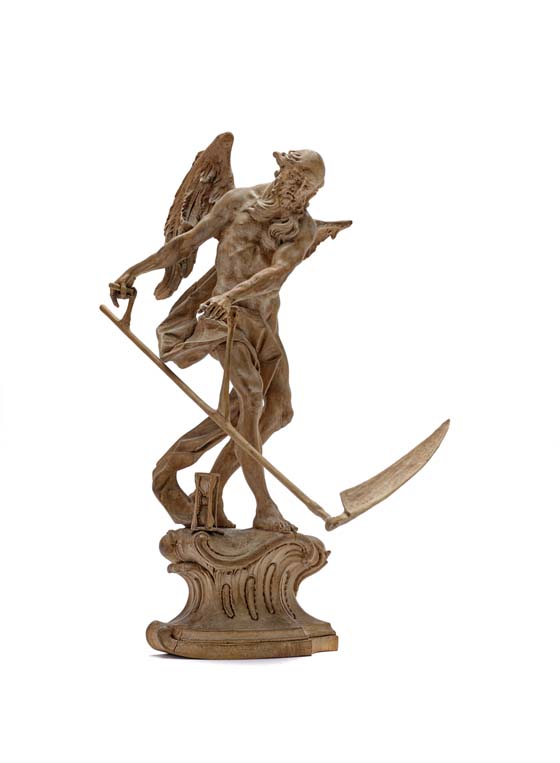
Chronos
Johann Wolfgang van der Auwera (1708-1756)
Würzburg, um 1740
Fruitwood with traces of red ochre paint
Height 30 cm
Published in: G. Laue / S. Mehringer (eds.): On the Wings of Time and Truth. The Hester Diamond Chronos, Munich 2022, p. 68, Fig. 36; Blumka Gallery / Kunsthandlung Julius Böhler (eds.): Collecting Treasures of the Past IV, New York / Munich 2004, Cat. No. 50
SOLD - Please contact us for similar artwork!
Chronos, the Father of Time, rises above an elegantly curvilinear Rococo base. Here he is represented as he is traditionally, as an old man with wings holding a scythe in his hands, a sandglass at his feet. In dynamic motion, he strides forward, beard waving as he swings his scythe. Conveying full body movement in striking parallels, his remarkably athletic torso is revealed at its best because it is insufficiently covered by a billowing loincloth caught up in the flow to flap around the rear leg. Attribution of this superb boxwood statuette to the Franconian sculptor Johann Wolfgang van der Auwera (1708–1756) is based on comparison with sculptures in both large and small formats by the artist that are held by several museums and ecclesiastical institutions and are in part confirmed as his work by archive records. Johann Wolfgang van der Auwera, who is viewed as the leading early Rococo master in Franconia, was born in Würzburg in 1708 as the son of the Flemish sculptor Jakob van der Auwera. Because of his precocious talent, Friedrich Carl Graf von Schönborn, who was Vice-Chancellor to the Emperor and Prince-Bishop of Würzburg and Bamberg, promote the artist with active sponsorship: at Schönborn’s suggestion and expense, the young sculptor stayed in Vienna from 1730 until 1736. There he came into contact with distinguished German Baroque sculptors, including Lorenzo Mattielli (1687–1748) and Georg Raphael Donner (1693–1741). On his return to Würzburg, Johann Wolfgang van der Auwera not only took over his father’s workshop but was also appointed artistic director responsible for redecorating the interior of the Würzburg Residence. While working on the Residence, van der Auwera managed to decorate and furnish several churches and received numerous commissions from the Schönborns both in Franconia and beyond its borders. The œuvre associated with van der Auwera consists mainly of sculpture in large formats that was intended for architectonic contexts. Nevertheless a few sculptures in smaller formats carved of limewood and boxwood have survived: apart from the Chronos discussed here, a Maria Immaculata in the Bayerisches Nationalmuseum in Munich and a pair of kneeling angels in the Museum of Fine Arts Houston are relevant in the present connection.