
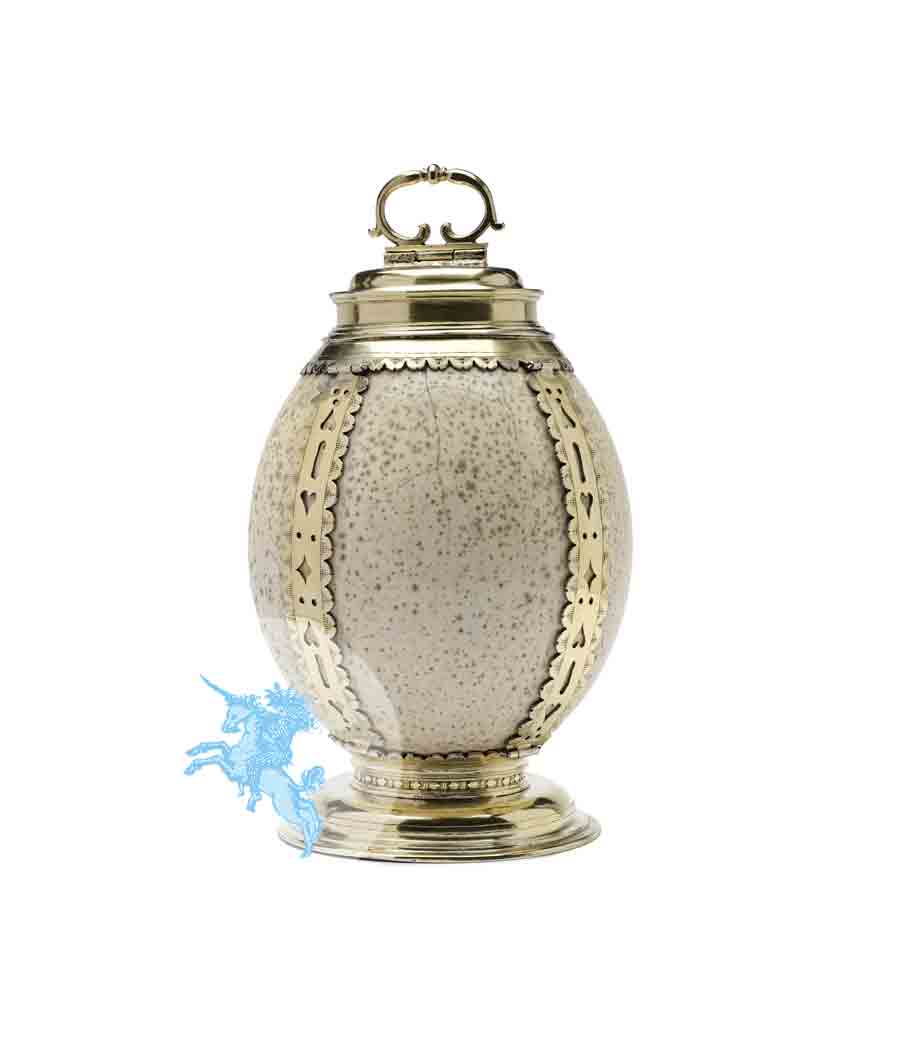
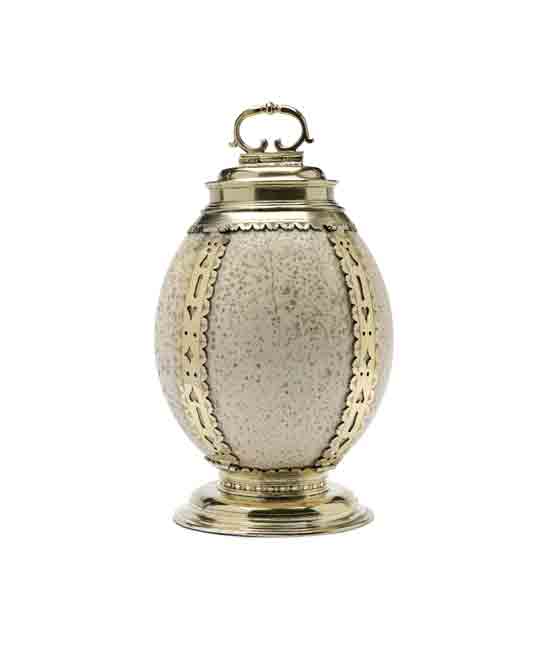
Ostrich egg screw-cap flask
from the Kunstkammer of the Margraves and Grand Dukes of Baden-Baden
South German, ca 1600
Ostrich egg, silver fire-gilt
Height 20 cm
Published in: S. Bock: Ova Struthionis. Die Straußeneiobjekte in den Schatz-, Silber- und Kunstkammern Europas, Heidelberg 2005, p. 255, Cat. No. 71, Fig. 126; S. Stangl: ‘Kunst- und Kuriosithätswert’: Die Kunstkammer der Großherzöge von Baden, in: Denkmalpflege in Baden-Württemberg 28 (1999), pp. 167–174, reproduced p. 167; A.M. Renner: Die Kunstinventare der Markgrafen von Baden-Baden, Bühl-Baden 1941 (=Beiträge zur Geschichte des Oberrheins, Vol. 1), p. 211, p. 259
SOLD - Please contact us for similar artwork!
The body of this flask is an ostrich egg left in its natural state and mounted in fire-gilt silver in the form of a screw-cap flask that is notable for the rarity and costliness of the materials used and mark it as an exotic treasure worthy of princes. The inventory labels glued on the bottom of the flask reveal that it was, in fact, a princely collector’s item: the numbers 3101 and 73 written in ink refer respectively to the 1883 and 1919 inventories of the Zähringen Museum, in which the artworks comprising the Collections of the Margraves and Grand Dukes of Baden-Baden are entered. The present ostrich egg flask really has been owned by the margraves and grand dukes of Baden-Baden since the seventeenth century. The silver mount of the screw-cap flask is informed by elegant simplicity: the body of the exotic vessel rising above a domed foot-ring consists of the egg of an African ostrich. It is encircled by three ornamental strap braces of sheet metal decorated with cut-card patterns that link the base with the mouth and the screw cap of the flask. Silver canisters with similar screw caps occur in south German silver from the early seventeenth century. Worth a mention are a comparable pair of ostrich-egg écuelles in the Green Vault in Dresden, which came into the possession of Johann Georg I, Elector of Saxony, in 1626 from the estate of Erdmuthe, Duchess of Pomerania (1561–1623), and were also made ca 1600. The magical and therapeutic powers imputed to the ostrich egg contributed to its popularity: like coral, coconut and rhinoceros horn, the ostrich egg was an apotropaicum, a substance believed to ward off evil that in the early modern age was used as a universal remedy for all sorts of illnesses and as a protection against poisoning. Valentini reported in his Museum Museorum (1714) pulverised ostrich egg shell was ingested as a remedy for kidney disease and antidote to poisoning. To match their healing and protecting properties, the eggs of the large African bird were often mounted as precious vessels. Valentini went on to remark on the value of ostrich eggs as collector’s items: ‘Whole eggs are kept in art and naturalia cabinets as a rarity’. Ostrich eggs can indeed be traced to the most important Renaissance Kunstkammer. Ostrich eggs mounted like the object studied here in the form of a screw-cap flask are, on the other hand, rare. Hence a second ostrich egg flask, which was also made ca 1600, in the Waddeston Bequest at the British Museum, is worth mentioning in the present connection.