
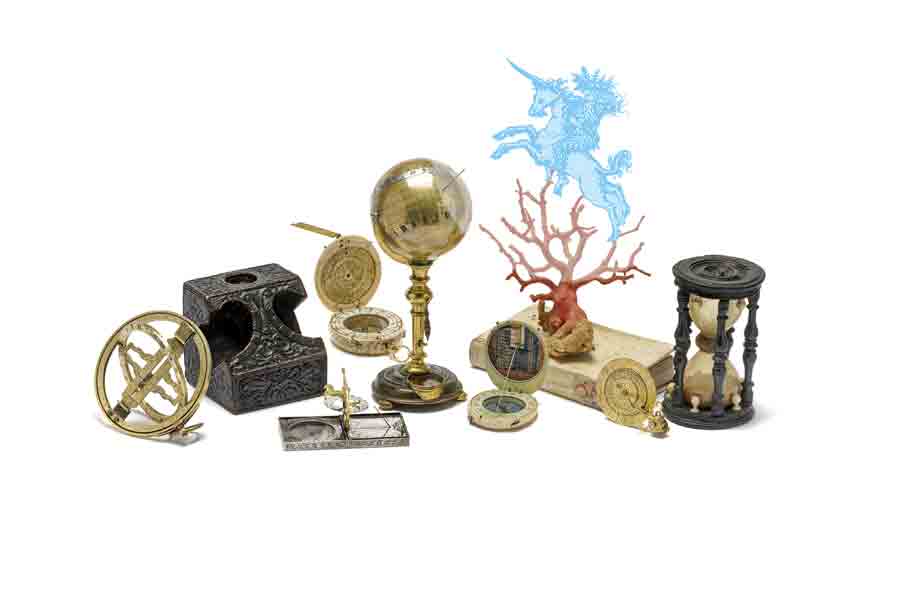
A Collection of Scientific Instruments
Renaissance and Baroque
German and French, 16th-18th centuries
Wood, silver, brass, ivory, glass
Height 4-18.5 cm
Outstanding scientifica from the Renaissance and Baroque period are presented, which encompass various elaborated sundials and other scientific instruments, crafted from precious materials such as silver and ivory. Since the 16th century, scientifica have played an essential part in the formation of Kunstkammer collections, especially at court. Scientific instruments represent one of the most important genres in the Kunstkammer because they were intended to vividly demonstrate that man is a small god: he is able to measure time and space with instruments and machines he has devised himself, and even to induce movement artificially through automata. Furthermore, in the context of princely collections, scientific instruments symbolically refer not only to man’s creative powers but to the ruler’s capability to gauge his surroundings, keep them under control, adapt them, and improve them. Hence, implements for measuring time and space prominently featured in the Kunstkammer of the early modern era. When the 10,000 exhibits in the Dresden Kunstkammer were inventoried for the first time in 1585, the share of mathematical and technical instruments included amounted to 950, among them 300 measuring instruments.