
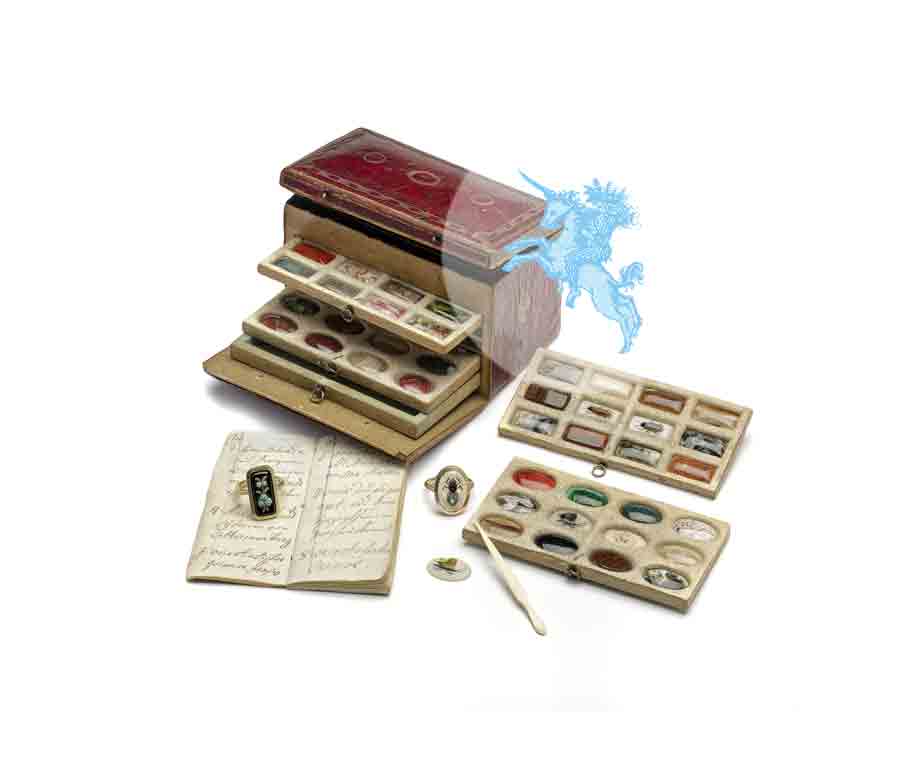
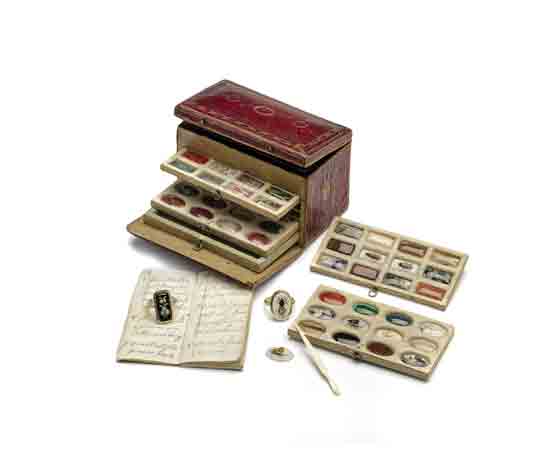
Court ring stone cabinet
Made by the Saxon gemstone cutter Heinrich Gottlob Lang (1739-1809)
Augsburg, ca 1770
Two rings of fire-gilt silver, 50 carved and polished gemstones, leather case, handwritten booklet
Height 8 cm, width 13 cm, depth 7 cm
Provenance: from ca 1880 to 2021 owned by the Charles Georgi family, France
SOLD - Please contact us for similar artwork!
Its little gold-tooled morocco leather case identifies this ring stone cabinet as a precious ‘lithoteque’ in a format suggesting personal use. Its hybrid character as a scientific collection, on the one hand, and as a fashion accessory intended for use in a flirtatious context on the other is confirmed by the catalogue included with the collection and the fire-gilt silver rings with which the cabochon-cut stones, all fifty of them, can be tried out on the recipient‘s finger. Remarkably, the case along with the complete set of cabochon-cut gemstones, two rings, the original bone implement for removing stones from the box and the catalogue included with them are all intact. This last was drawn up by the gem cutter who was responsible for this artwork: Heinrich Gottlob Lang (1739–1809), who was active in Augsburg in the third quarter of the eighteenth century. Only a few ring stone cabinets of his are extant in public collections and in private hands. The handwritten ‘Catallogus’ elevates the ring stone cabinet as an object to scientific-study status since it is presented as a mineralogical collection. Not by chance, the invention of the ring stone cabinet coincides with the era of the Enlightenment, when minerology became established as a scientific discipline within the field of geology. Particularly popular in the latter half of the eighteenth century, mineralogical collections underwent a noticeable upturn at both courts and in patrician circles because they were regarded as status symbols and represented testimonials to their owners’ erudition. Ring stone cabinets like the one discussed here should not, however, be interpreted as purely scientific objects. On the contrary, they are exquisite and expensive luxury objects that did not necessarily target scholars, but rather rich collectors. A native of Dresden, Heinrich Gottlob Lang (1739–1809) worked in Augsburg from 1764. He is verified as a maker of ring stone cabinets containing some cabochon-cut stones with virtually identical representations of insects in stone relief. A signed example of his work is held by the Maximilianmuseum in Augsburg. Also worth mentioning in this connection is a snuffbox by the same artist in 1770 and now in the Naturhistorisches Museum in Vienna. For this extremely elaborate and exquisitely worked gemstone piece Lang designed minute stone elements in the form of insects, flowers, stripes and a putto, which he applied to the wall of the stone box. He recorded the types of stones he worked for the piece in an extensive, illustrated inventory that he signed as ‘Heinrich Gottlob Lang Cutter of precious stones and armorial bearings‘ and dated ‘Augsburg, Ao 1770’. Its exquisite appearance and value as a mineralogical rarity are qualities that are sure to have justified adding this sophisticated snuffbox to the Imperial collections: in 1778 the Empress Maria Theresia donated it to the Minerals Collection, to which she had already caused several other major works by gem cutters in the Imperial collections to be transferred.