
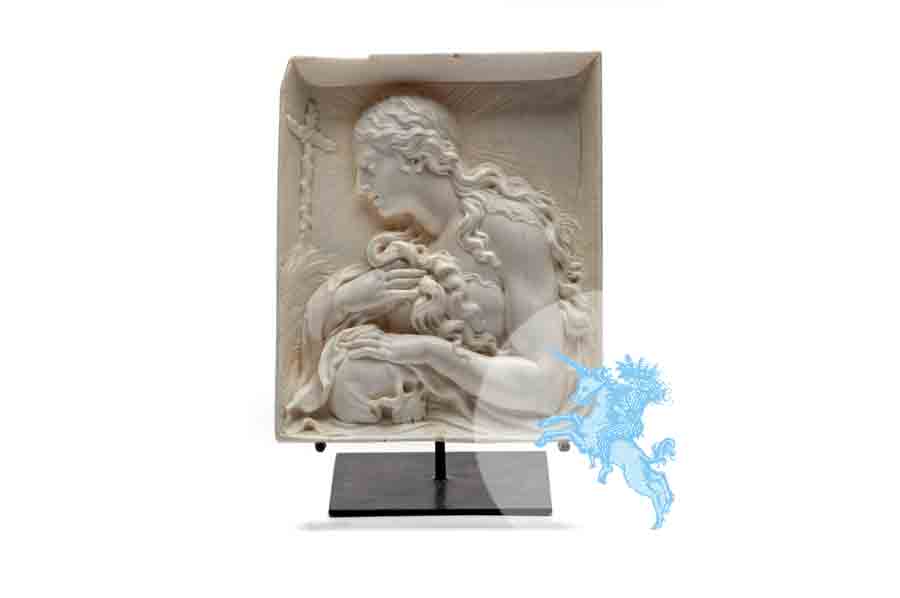
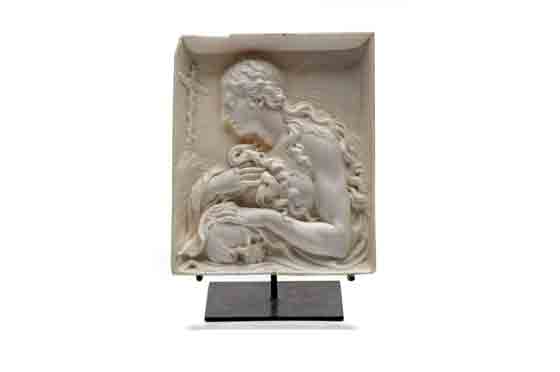
Saint Mary Magdalene
Francis van Bossuit (1635-1692)
Amsterdam, ca 1680
Ivory, modern iron base
Height 14.5 cm, width 12 cm, depth 2 cm
Published in: M. Pool: Cabinet de l’art de sculpture / par le fameux sculpteur Francis van Bossuit. Executé en yvoire ou ebauché en terre gravés d'apres les desseins de Barent Graat, par Mattys Pool, Amsterdam 1727, Plate LXXXVIII
This superlatively executed ivory relief of exceptionally high sculptural quality shows Saint Mary Magdalene as a Penitent in the Wilderness. The saint is depicted naked as a remorseful sinner, wearing her hair loose and dishevelled. As a sign that she has rejected worldly things, she rests her hand on a skull that at the same time functions as a vanitas symbol. Remarkable features of the work are the turbulent composition of the relief, its pronounced plasticity as well as the realism of the representation, which is particularly noticeable in the detailed handling of the hair and anatomical features of the saint’s body as well as the skull. That this exquisite relief is a work by the celebrated sculptor Francis van Bossuit (1635–1692) is verified by the compendium of copperplates of the artist’s work that Matthijs Pool published in 1727 after Bossuit’s death; the relief discussed here is reproduced in it as Ste Magdeleine. Basrelief d’Ivoire. In addition, Bossuit’s authorship is confirmed by the stylistic affinities of the work with various ivories by the sculptor that are held by the Bayerisches Nationalmuseum in Munich, the Musées royaux d’art et d’histoire in Brussels, the Museo degli Argenti in Florence, the J. Paul Getty Museum in Los Angeles and the Thomson Collection in the Art Gallery of Ontario, all of which are authenticated as works by Bossuit’s own hand because they are reproduced in the Matthijs Pool copperplate compendium. Francis van Bossuit was one of the most influential and important ivorists working in Italy and the Low Countries during the latter half of the seventeenth century. His status is attested by the copperplate compendium in a large format (1727) in which the Dutch copperplate engraver Matthijs Pool presented the sculptor’s œuvre in a series of ninety-five plates. In his introduction to this sumptuous publication, Pool outlined Bossuit’s unusual biography: born in Brussels in 1635, the artist went to Antwerp before setting out ca 1655 for Italy, where he ‘spent his youth and the best years of his life’. He lingered in Rome for about twenty-five years. Before 1685 he returned to the Netherlands and settled in Amsterdam, where he worked until his death in 1692.