
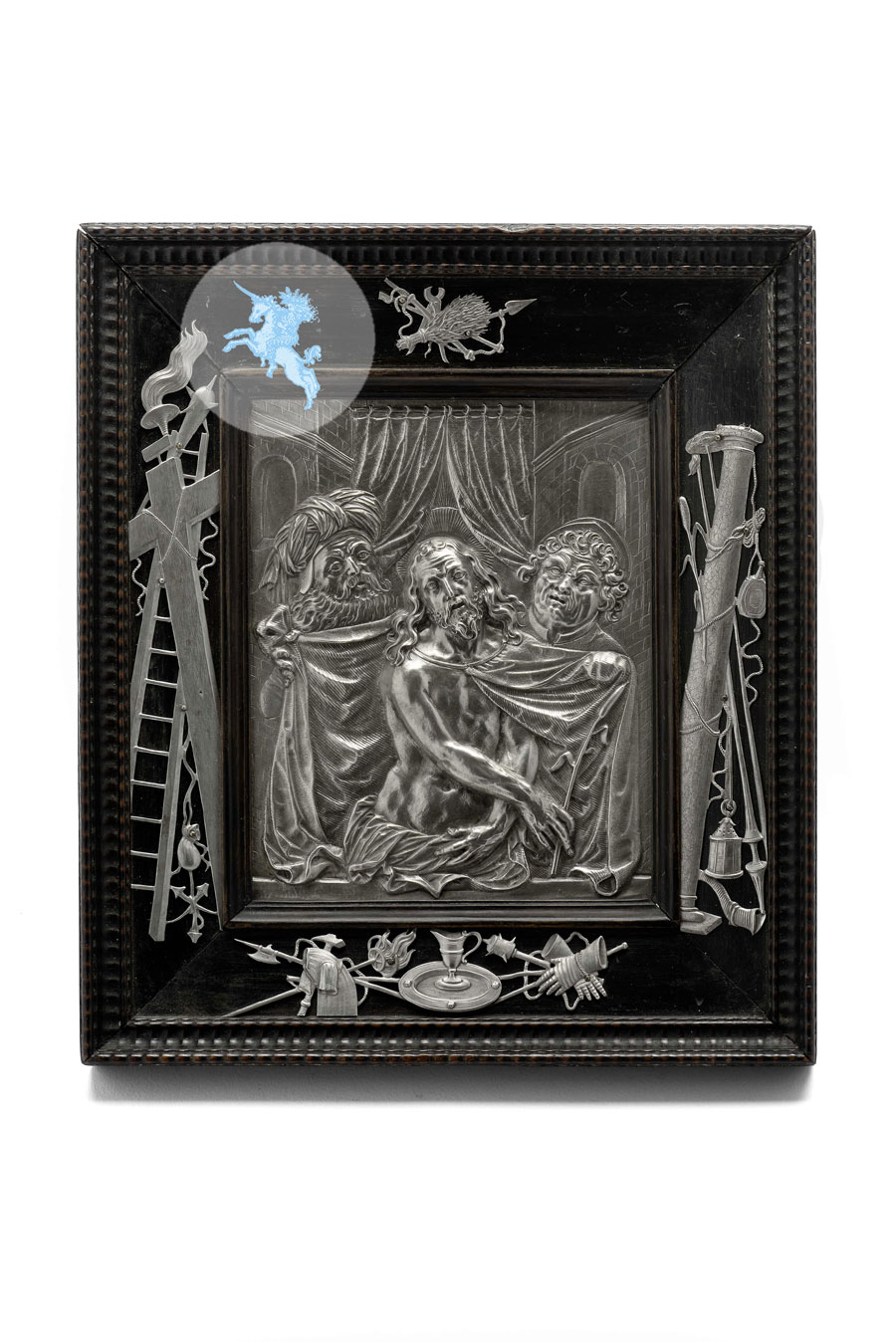
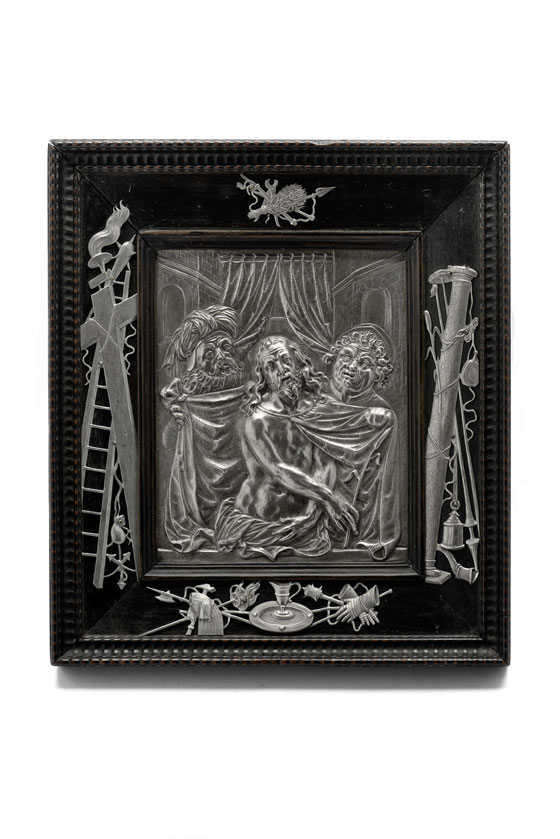
Ecce Homo
Martin Luther and Pontius Pilate presenting Christ
Christoph Lencker (Master 1584–1613), attr.
Augsburg, ca 1600
Silver, embossed, chased, original wooden frame
Dimensions of frame: 24 x 21 cm
Provenance: Cologne, Private collection
Published: Laue, G.: Wunder kann man sammeln. Merveilles à collectionner, Munich 2006, p. 18
‘Ecce Homo’, ‘Behold the man’ (John 19: 5) those words were spoken by Pontius Pilate, governor of the Roman province of Judaea, when he presented Jesus of Nazareth, wearing the Crown of Thorns and clad in a purple robe after the scourging, to the mob, headed by Caiaphas, the High Priest, thus making clear that he finds no fault in Jesus. This frequently depicted episode from the Gospel of Saint John is shown on the present silver relief staged with almost hyperbolical drama, with the cast condensed to only three characters: Christ stands at the centre of the picture in front of a stone balustrade between Pontius Pilate and his helper. Whereas Pontius Pilate is represented as a bearded man wearing a turban, on the right, the usual soldier or henchman has been replaced by a man sporting a beret on a mop of curly hair, who looks as if he had been transplanted from a Renaissance portrait. In fact, a contemporary observer would have identified the figure as Martin Luther on the spot. The recognition effect is reinforced, on the one hand, by the distinctively rugged facial features and, on the other, by the characteristic headgear, both of which recur on numerous prints and paintings depicting the Reformer. The circumstance that Luther appears here playing a principal role in New Testament events is closely linked to the veneration of the Reformer that had already set in during the sixteenth century and led to Luther’s quite often being portrayed with a halo or even as a saint. Hence the present Ecce Homo panel represents not only a precious devotional object but also a profession of religious affiliation. The exceptionally high quality of the repoussé work and the political and religious scope and significance of the iconography suggest that this work was treasured as a Kunstkammer object of the first water, which would have whetted the appetite of any princely collector who affirmed the Reformation.