
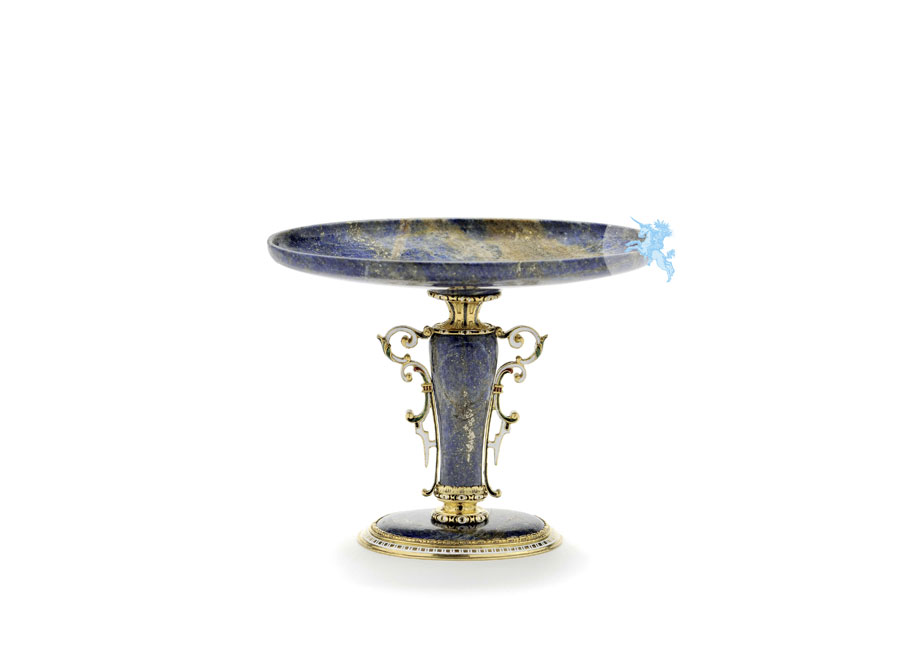
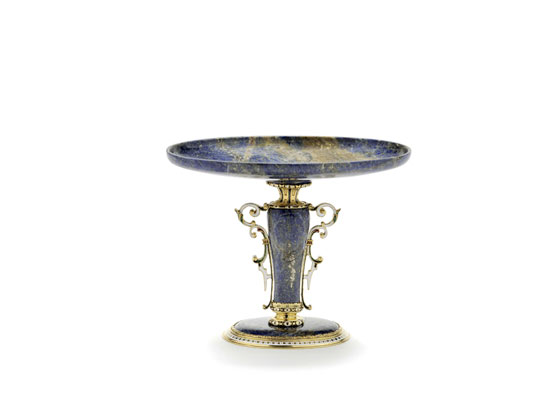
Lapis lazuli tazza
Gasparo Miseroni (ca 1518-1573), attr.
Milan, ca 1570
Lapis lazuli; mount: gold, enamel
Height 7.5 cm, width 9.5 cm, depth 6 cm
Provenance: France, private collection
Published in: Laue, G.: Tresor. Treasures for European Kunstkammer, Munich 2017, pp. 150-151, pp. 230-231, Cat. No. 40
This exquisite tazza consists of a shallow, oval bowl, a baluster-shaped shaft and a round foot of lapis lazuli that is held together by a superlative mount of enamelled gold. Both the stone-cutting and the mount are typical of Milanese artworks from the latter half of the sixteenth century. A lapis lazuli shell bowl on a baluster foot in the Württembergisches Landesmuseum boasts a similar gold mount. That superb piece, executed by Gasparo Miseroni (ca 1518-1573) ca 1560/70, was owned by Barbara Sophia, Duchess of Württemberg (1584-1636), in the early seventeenth century and in 1669 found its way into the Kunstkammer established by Eberhard III of Württemberg (r. 1628-1674). There are similar works of Miseroni’s in cut stone in the collections at the Louvre in Paris and the Museo degli Argenti in Florence. In the Renaissance, lapis lazuli was one of the rarest and most valued semi-precious stones since it was extracted in today’s Afghanistan and had to be imported at great cost to Europe. Basically worth its weight in gold, the deep blue stone would be fashioned into the most impressive and valuable artworks in the workshops of Milanese artists like the Miseroni’s who worked almost exclusively for a princely clientele. The enamel gold mount of the elegant tazza testifies to the high esteem in which this exquisite artwork was hold in the late 16th century.