
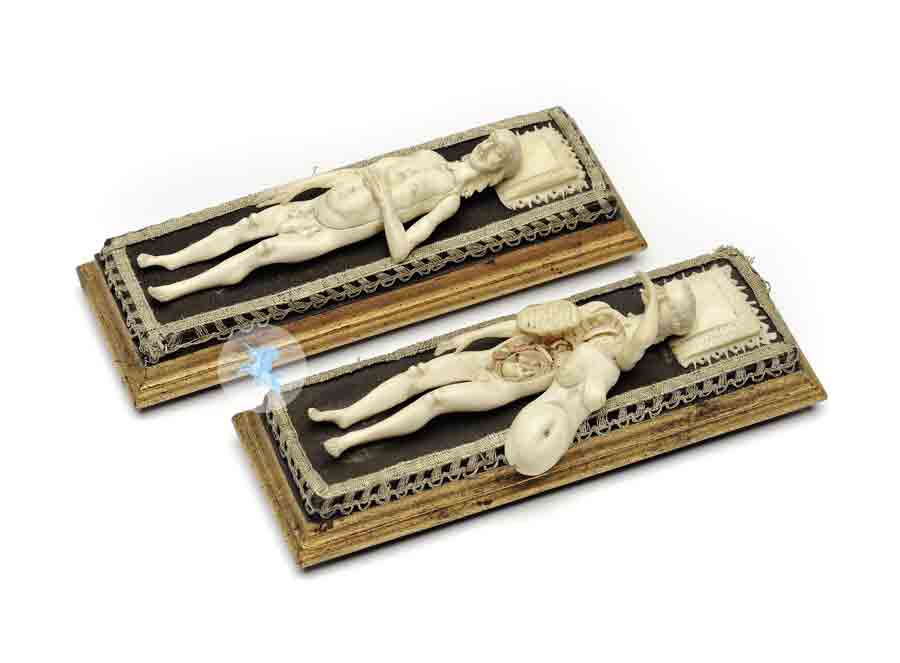
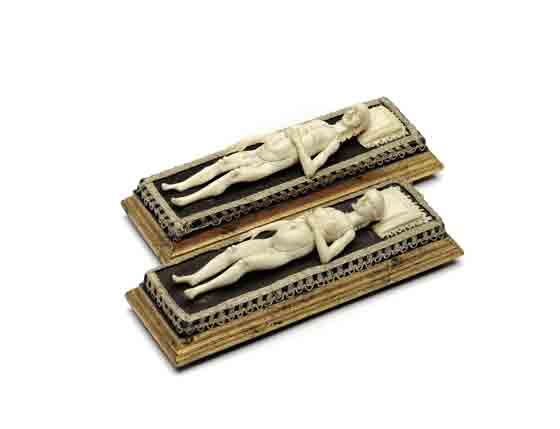
Anatomical model of a pregnant woman and a man
Stephan Zick (1639-1715)
Nuremberg, ca 1680
Ivory; cloth; silver borders; wood; cardboard box
Length of the female and male figure: 14.5 and 15 cm
Published in: Adler, S. (ed.): BODY SCAN. Anatomie in Kunst + Wissenschaft, exhibition at the ERES-Stiftung, Munich 2018, p. 97
SOLD - Please contact us for similar artwork!
In the seventeenth century anatomical models in miniature form were among the most sought-after collector’s items for Kunst- and Wunderkammer. The Nuremberg workshop of Stephan Zick (1636–1715), an ivory turner, made ivory anatomical models, most notably of pregnant women, from which some of the individual organs were removable. The ivory body is furnished with movable arms and the abdominal wall lifts off to reveal the inner organs, including a uterus with embryo, which can also be disassembled. Several models of pregnant woman by Stephan Zick are extant in public museums and private collections, for instance at Museum für Kunst und Gewerbe in Hamburg and in the Olbricht Collection in Essen. Models of a man and a woman as a couple, however, are extremely rare. The present objects are the more noteworthy for being preserved in their original cardboard case still bearing its red wax seal. A comparable pair of anatomical models of a man and a woman belongs to collections of the Harvey Cushing / John Hay Whitney Medical Historical Library at Yale University. The popularity of Zick’s models is due to the avid interest early-modern-age collectors felt in anatomical knowledge but these ivory treasures are unlikely to have been used as teaching aids to illustrate medical issues. On the contrary, they are typical Kunstkammer objects, intended to whet visitors’ curiosity and provided with tactile qualities that invited exploration with a hands-on approach. At the same time the precious material used to make them and the superlative workmanship lavished on them in turning them into art indicates that models of this kind were viewed as artificialia of the first water, which, even more compellingly than other works of art, demonstrated man’s ability to penetrate the secrets of Divine Creation.