
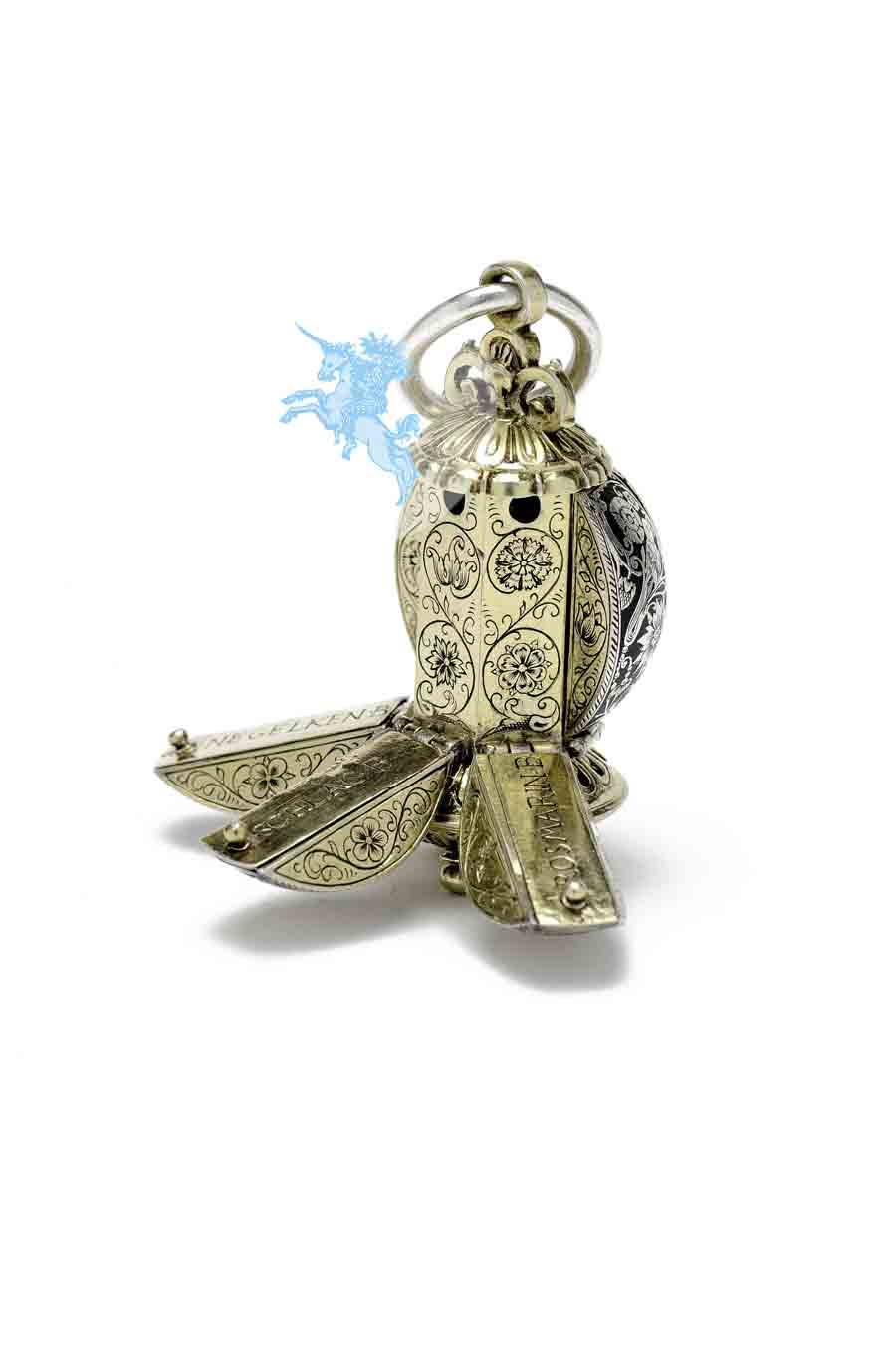
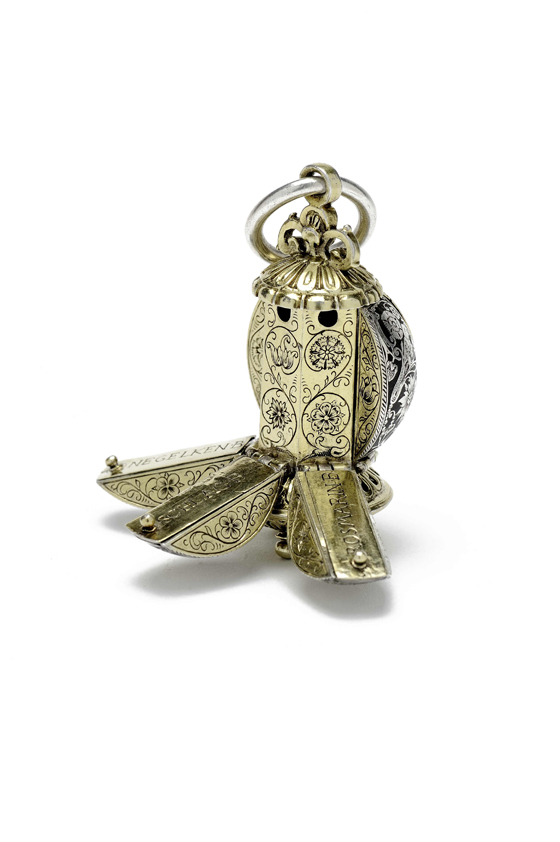
Renaissance Pomander
German, ca 1620
Silver, cast, chased, chiselled, engraved, partly open worked and fire gilt; niello
Height 7 cm
Published in: Laue, G.: Tresor. Treasures for European Kunstkammer, Munich 2017, pp. 132-133, pp. 220-221, Cat. No. 30; Laue, G.: The Kunstkammer. Wonders are collectable. Kunstkammer Edition, vol 1, Munich 2016, p. 142
SOLD - Please contact us for similar artwork!
What appears to be an ovoid silver pendant with engravings and niello is in fact a particularly rare receptacle for various scents and medicinal substances, a so-called pomander. The name ‘pomander’ is derived from the French ‘pomme d’ambre,’ meaning ‘amber apple,’ i.e. an apple-shaped container for musk, perfumes, spices and ointments. Spices and scents were considered to be valuable and rare substances during the Renaissance, for they were acquired from foreign lands and subsequently sold at high prices. Thus the pomanders made to hold these expensive substances were also particularly precious and refined works themselves. Pomanders were worn as jewellery and were usually hung at the waist or worn around the neck. Such items emphasised the owner’s wealth and high social standing. This explains why the present pomander is so richly adorned with niello and engravings on the outside as well as inside each individual compartment. The main body of the pomander depicts engraved birds in tendrils of flowers and plants that stand out from the dark background of the niello. It consists of six hinged compartments that open like segments of an orange when one unscrews the top ring. Each section is richly engraved with flowers and fitted with a narrow lid, on which the name of the substance stored inside is engraved: ‘canel’ (cinnamon), ‘muscat’ (nutmeg), ‘rosmarin’ (rosemary), ‘schlag‘ (i.e. Schlagbalsam, an ointment used for strokes and seizures), ‘negelken‘ (cloves), and ‘rosen’ (rose). These segments close on a hexagonal core with small holes at the top. This hollow column was also used for storing scents. The pomander’s base is an open-worked capsule that would have once housed a small sponge to absorb and diffuse fragrances. Moreover, all of the compartments inside the pomander can be unscrewed or otherwise opened to refill the scents on a regular basis. Popular during a time when scents were said to have healing properties, pomanders became luxury items essential to preserving one’s health. Still, only very few could afford these precious items as well as the spices and scents contained within them. Thus one often finds pomanders depicted in portraits, worn by princes and members of the nobility, wealthy merchants and influential burghers. While such objects from the late 17th century can be seen in several public and private collections, early pomanders from around 1620 are quite rare. Two nearly identical piece with engravings of flowers with niello are displayed at the Victoria and Albert Museum in London and at the Ashmolean Museum in Oxford.