
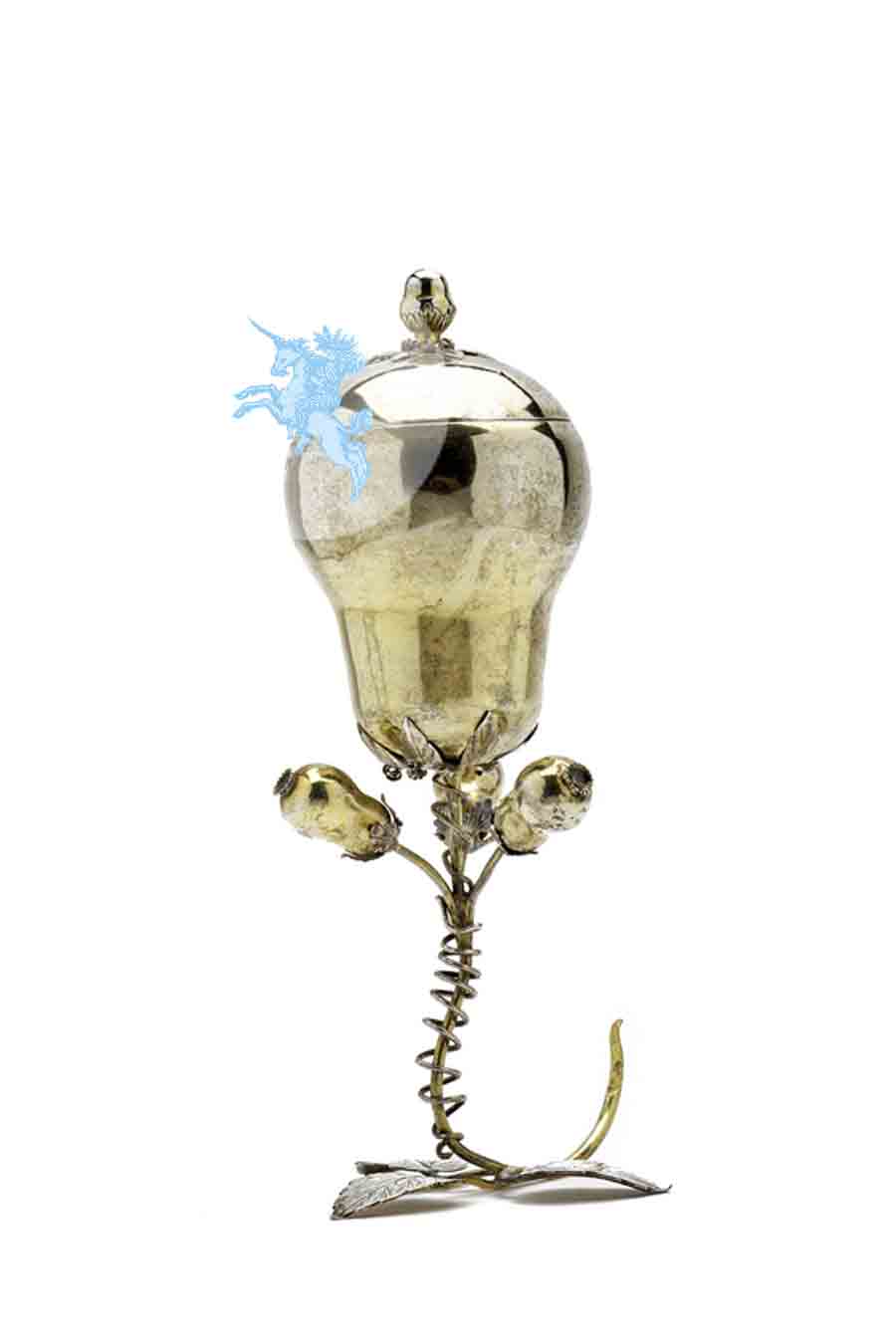
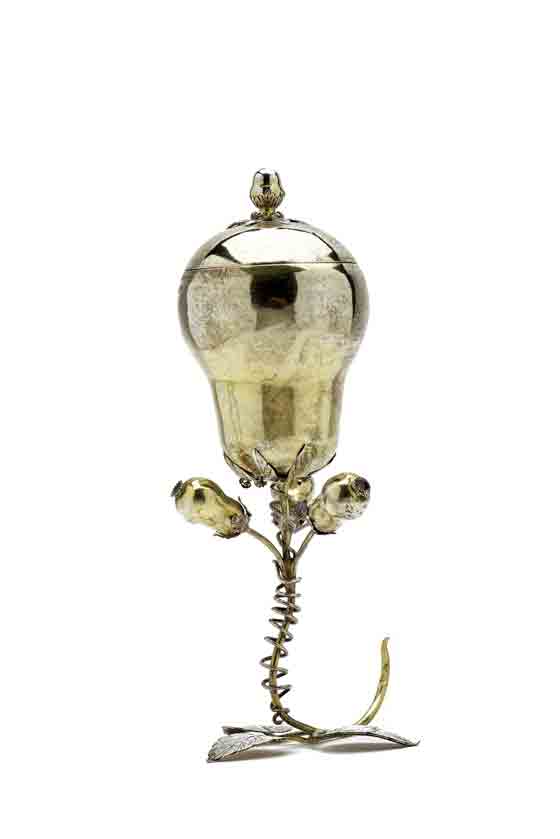
Pyriform covered cup
Oswald Haußner (master 1637–1671)
Nuremberg, 1650–1657
Silver: embossed, cast, engraved, cut, parcel-gilt
Nuremberg town mark, wriggled assay groove and master maker’s mark OH on the rim of the cup and on the cover
SOLD - Please contact us for similar artwork!
Its naturalistic design marks the present pyriform cup as a piece superlatively worked to the highest quality standards by a south German goldsmith: three leaves form the foot of the cup, from which rises a slender stem entwined with a spiralling reinforcing element out of which grows the pyriform bowl of the cup. Three pears on a much smaller scale are mounted on stalks to frame the cup and enhance the dominant motif. The town and master maker’s marks on the lip of the cup and the cover verify that this is a work dating from ca 1650–1657 by the Nuremberg goldsmith Oswald Haußner (master 1637–1671). As a master goldsmith Haußner specialized in ostentatious cups and salt cellars, some of which are extant at the State Hermitage in St Petersburg, the Germanisches Nationalmuseum in Nürnberg and the Museum für angewandte Kunst in Vienna. Magnificent standing cups formed as apples or pears were made at two south German goldsmithing centres: Nuremberg and Augsburg. As models the local master goldsmiths had imaginative designs for fantastic vessels at their disposal, prints by Nuremberg printmakers such as Virgil Solis, which decisively expanded the Late Gothic repertory of forms. The popularity of fructiform covered cups made by Nuremberg and Augsburg goldsmiths was at its zenith in the first half of the seventeenth century. Pineapple and pear cups especially were among the functional table decorations deemed indispensable at courts. From the sixteenth century on magnificent drinking vessels of fire-gilt silver with bowls in the form of apples or pears and shafts shaped as tree trunks or branches were particularly popular at German courts. Such elaborate testimonials to the goldsmith’s craft were usually treasured as precious vehicles for princely ostentation, but also represented sound investments because they could be melted down and literally ‘turned into cash’ when the times were hard. Since they were so aesthetically and materially valuable, they were usually kept in treasury vaults to which only the prince and his steward had access. On festive occasions at court, such as births, weddings, diplomatic receptions and the like, the precious covered cups were taken out of the treasury vault and set up on the princely banqueting board or on a three- or five-tiered credenza behind the table to signalize the host’s power and wealth.